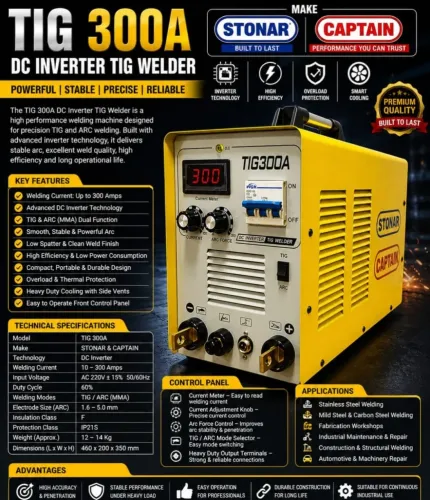
Construction companies can use MIG welding machines for workshop fabrication and controlled site work, especially on mild-steel frames, gates, railings, brackets and equipment supports. The right choice depends on the metal, joint thickness, outdoor exposure, power supply, welding code and complete equipment setup—not the advertised amp rating alone.
Key takeaways
- Use MIG for clean mild-steel fabrication and controlled site welding.
- Match wire diameter, shielding gas and polarity to the base metal.
- Protect shielding gas from wind with screens and leak-free connections.
- Compare duty cycle and output at working amperage, not peak amps.
Where MIG welding fits in construction work
Yes. Construction companies in Ahmedabad can use a MIG welder for construction in workshops and controlled site work. Suitable jobs include mild-steel frames, gates, railings, handrails, brackets, equipment supports, ductwork and light structural assemblies. It is less suitable for heavily contaminated surfaces, exposed windy locations or critical load-bearing joints without an approved welding procedure.
| Job | What MIG/MAG does | Main boundary |
|---|---|---|
| Workshop frames and supports | Makes continuous fillet and butt welds efficiently | Clean, accurately fitted joints produce better results |
| Gates, railings and handrails | Joins thin and medium-gauge mild-steel sections with controlled heat | Excessive current can burn through thin tubing |
| Brackets, ductwork and equipment supports | Produces repeatable joints during fabrication and installation | Access, fit-up and welding position still control quality |
| Structural-steel connections | Can weld approved joints in suitable steel | Engineer-approved procedures, qualified welders and inspection may be required |
The process feeds a continuous solid wire electrode through a torch. An electric arc forms between the wire and the workpiece, melting both the wire and the joint edges; shielding gas protects the molten pool from air.
Carbon-steel work commonly uses CO2 or an argon–CO2 blend, so the technically precise term is MAG, while “MIG” remains the widely used trade description.
Wire diameter and current let you control heat on thin and medium sections. Very thick members can require preheating, larger wire and multiple passes, while galvanized or coated steel demands fume controls and local exhaust ventilation; a machine’s built-in fan is not fume extraction.
For load-bearing work, check the project code, weld procedure, inspection rules and acceptance criteria before treating ordinary MIG welding applications as structural approval.
Match the wire, gas and metal to the joint
Choose a welding machine for construction work by the joint’s metal and thickness, not its advertised maximum plate capacity. Solid ER70S-class wire suits ordinary carbon-steel frames, gates, railings, brackets and supports; select wire diameter and current to control heat on thin and medium-gauge members.
A thick load-bearing joint may need preheating, larger wire and multipass welding.
| Metal or joint | Wire and shielding gas | Suitable use |
|---|---|---|
| Carbon steel, about 1–12 mm | ER70S-6 solid wire, 75/25 argon–CO₂ blend or CO₂ | Fabrication, frames, gates, railings and light structural assemblies |
| Stainless steel | Stainless solid wire matching the grade, argon-rich gas blend | Handrails, ductwork and corrosion-resistant components |
| Aluminium, thin to medium sections | Aluminium wire, pure argon, aluminium contact tips and liner or spool gun | Aluminium frames and components; use only with a correctly configured feeder |
| Thick carbon-steel sections | Larger solid wire or gas-shielded flux-cored wire, with procedure-specified gas | Multipass structural joints requiring controlled heat and penetration |
CO₂ gives deeper penetration and more spatter; an argon–CO₂ mixture gives a smoother arc and cleaner appearance. Specify the wire classification, diameter and gas together rather than buying a machine labelled only “MIG.” Technically, carbon-steel welding with CO₂ or an argon–CO₂ blend is MAG because the gas is active.
Do not convert a steel-wire feeder to aluminium casually. The wrong drive rolls or liner can bird-nest soft wire and contaminate the weld. For load-bearing steel, also confirm the project code, qualified procedure, welder qualification, consumable traceability and inspection criteria before welding.
Make gas-shielded MIG work on an Ahmedabad site
MIG works reliably outdoors in Ahmedabad only when the site controls wind, contamination, shielding gas and electrical supply. A wind screen around the joint is essential; raising gas flow alone creates turbulence and can pull air into the weld.
Check these conditions before striking an arc:
- Use a clean, dry wire spool and store it covered against dust and moisture.
- Inspect the regulator, hose, connections and torch for gas leaks.
- Clean the liner and contact tip; bird-nesting and uneven feeding often indicate contamination.
- Confirm the machine’s input rating, earthing, extension cable size and generator capacity match the site supply.
- Keep the nozzle close to the joint and shield the work from gusts, not just the operator.
These checks protect common MIG welding applications such as frames, gates, railings, brackets and equipment supports. A machine selected as MIG welding equipment in Ahmedabad still needs local exhaust ventilation or another effective fume-control method; its cooling fan is not fume extraction. Galvanized or painted steel demands additional controls because its coatings produce hazardous fumes.
If wind screens are impractical, use self-shielded flux-cored wire instead of gas-shielded MIG. It handles exposed work better and avoids cylinder logistics, but it creates slag and more smoke: remove slag between passes and apply suitable respiratory and fume controls.
For load-bearing steel, follow the engineer-approved specification, qualified welding procedure, welder qualification, consumable traceability and inspection criteria before site fabrication begins.
Choose a machine from its working capacity, not its peak amps
Compare a MIG welder for construction by rated output at the intended duty cycle, not its peak amperage. For a workshop or mobile welding machine for construction work, match the current range to your wire diameter, joint thickness and welding position before comparing features.
| Machine type | Working characteristics | Best fit | Check before buying |
|---|---|---|---|
| Transformer MIG | Heavy, robust and mechanically simple; output is sustained only within its duty-cycle rating | Fixed workshop fabrication and regular carbon-steel work | Weight, input phase, voltage, duty cycle and available replacement parts |
| Inverter MIG | Lighter, more portable and usually offers finer control over voltage and wire-feed settings | Mobile teams, site repairs and workshops with limited handling capacity | Generator compatibility, input-voltage tolerance, thermal protection and service support |
| High-amp model | A high peak number does not prove continuous production capacity; the advertised output may require three-phase power | Thick sections that match the project specification | Rated amperage at 40% or 60% duty cycle, not only the maximum figure |
Ask for the output graph or rating at your intended current. A machine claiming 300 A at a short duty cycle may deliver less practical work than a 250 A model rated for longer operation, while repeated thermal shutdowns interrupt fabrication.
Check these selection points:
- Wire-feed range for the chosen solid-wire diameter
- Single-phase or three-phase input and voltage
- Thermal cut-out response and restart behaviour
- Generator starting watts, running watts and waveform compatibility
- Cable length, torch rating and machine weight
Choose from the thickest routine joint and welding position you expect, not an occasional maximum plate claim. Very thick structural members can demand multipass welding, preheating or another process.
Verify compliance, safety and the complete supply package
Before placing a work order, match the machine, consumables and paperwork to the joint you will actually weld. A MIG welding machine for construction companies in Ahmedabad is suitable only when its rated duty cycle, input supply, wire range and protection match your workshop or site conditions.
1. Ask for the output rating at a stated duty cycle, not only the maximum amperage. Confirm input voltage, phase, earthing arrangement, wire diameter range, torch length and feeder capacity.
2. Specify the metal, thickness, welding position and joint type. For carbon steel, confirm the solid wire classification, diameter and shielding gas together; do not accept a quote that says only “MIG welder.”
3. Confirm the complete package: welding torch, earth lead and clamp, wire feeder, regulator-flowmeter, gas hose, contact tips, liner, drive rolls, spare fuses, operating manual and warranty terms. Record each item on the quotation.
4. Require an on-site safety check for cable damage, gas leaks, cylinder restraint, ventilation and protective screens. A machine fan is not fume extraction; use local exhaust ventilation where practicable, especially with galvanized or painted steel.
5. For documented fabrication, ask whether the supplier can provide serial-number records and technical documents needed for your quality system. ISO 3834 governs welding-quality control, not machine approval or weld strength.
Shree Kesar Enterprise can clarify whether its MIG welding equipment in Ahmedabad includes the accessories and consumable setup your specified joint requires, rather than leaving those items for separate purchase.
Related products
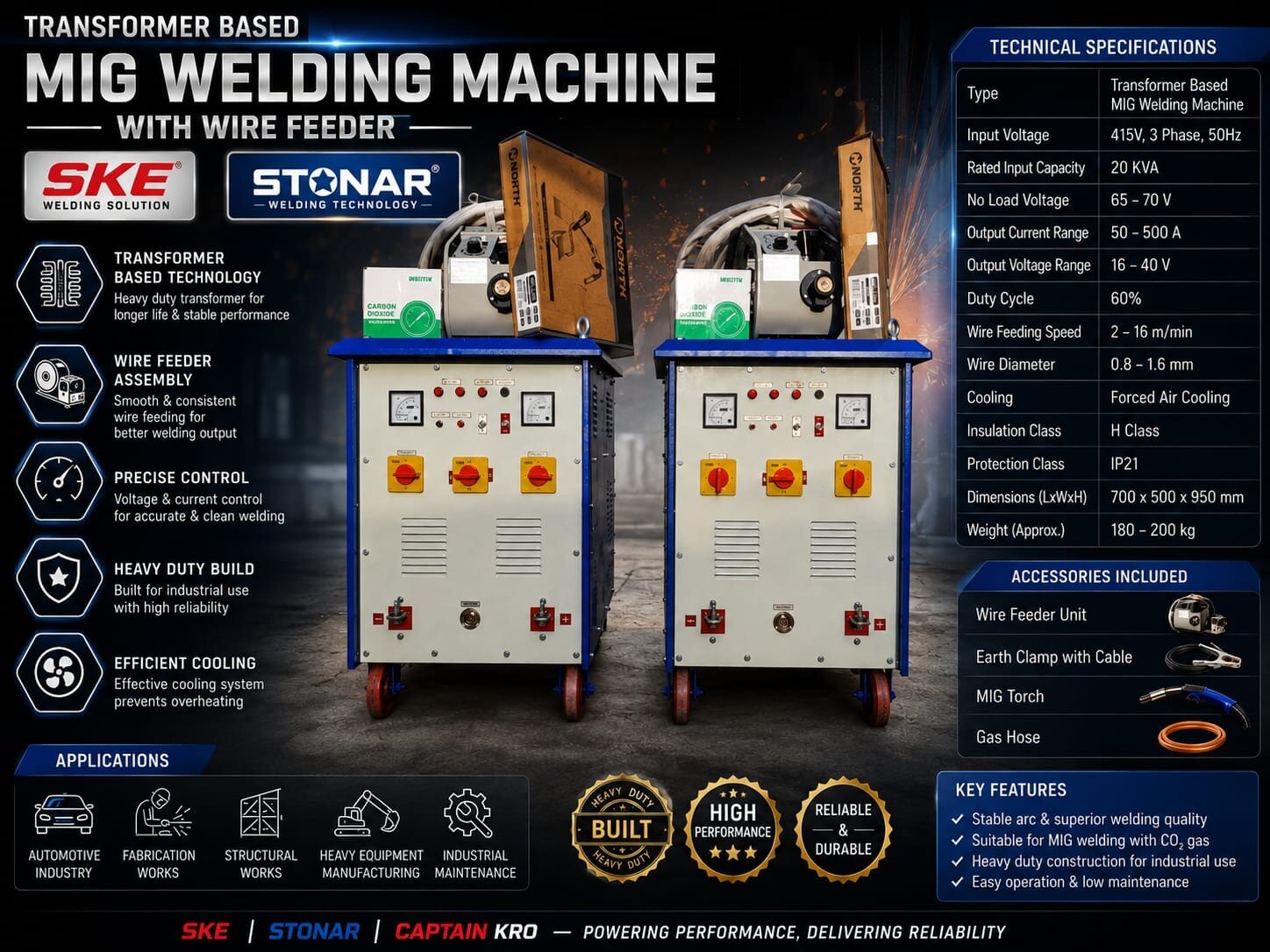 | WELDING MACHINE TRANSFOMER BASED MIG WELDING MACHINE The Transformer Based MIG Welding Machine from Shree Kesar Enterprise, Ahmedabad is a robust and reliable welding solution designed for continuous... View product → |
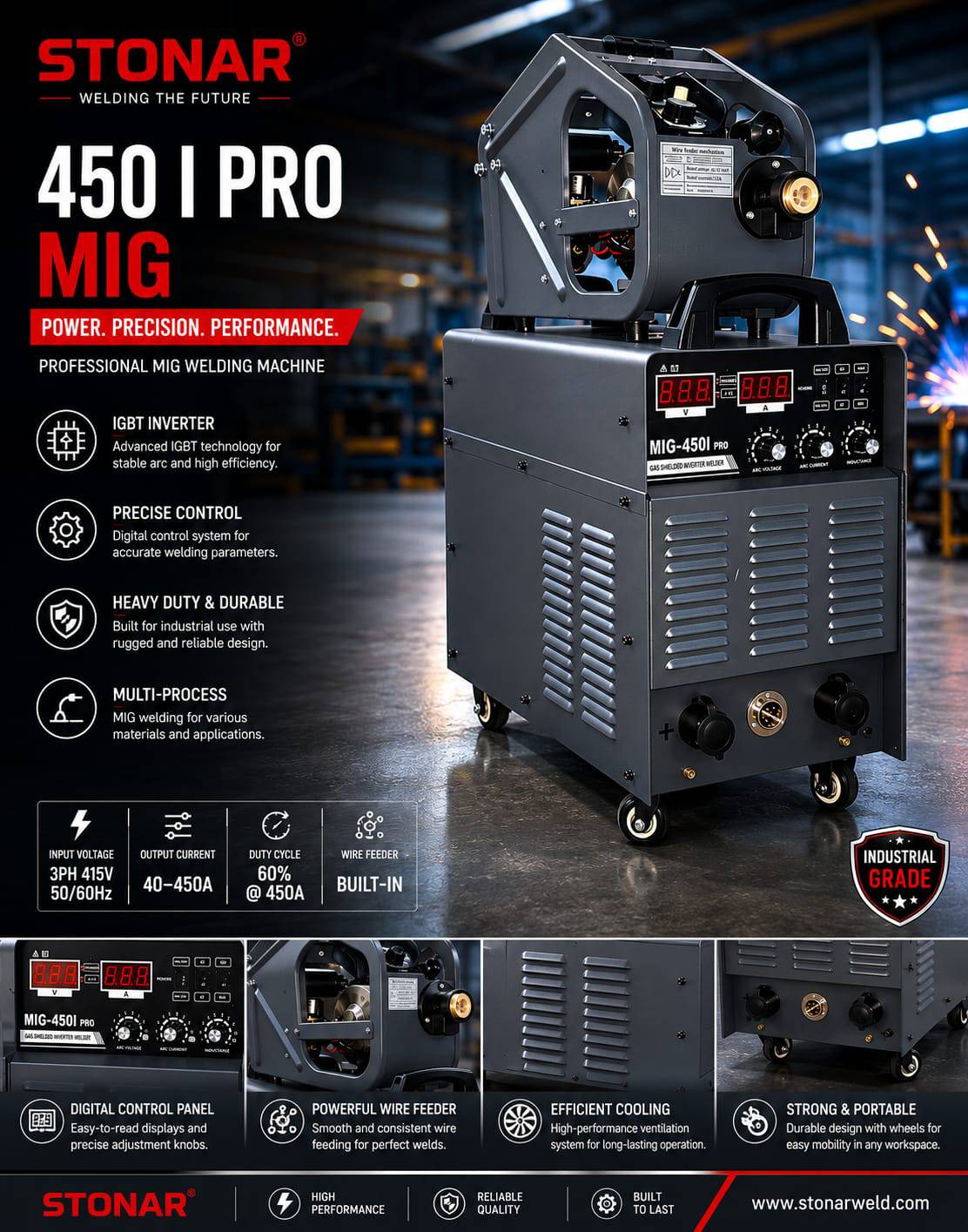 | WELDING MACHINE MIG 450 AMP CO2 Welding Machine is a heavy-duty industrial welding machine designed for continuous and high-performance fabrication work. View product → |
Frequently asked questions
Can construction companies use MIG welders in Ahmedabad?
Yes. MIG welders suit workshops and controlled sites for frames, gates, railings, brackets, supports, ductwork and light structural assemblies. Avoid exposed windy areas, contaminated steel and critical load-bearing joints without an approved welding procedure.
What must you match before starting a MIG weld?
Match the wire type and diameter, shielding gas, polarity and machine settings to the base metal and joint. Clean the steel and confirm the joint procedure before welding.
How can you use gas-shielded MIG on an Ahmedabad construction site?
Use wind screens, secure the cylinder upright, check hoses and regulators for leaks, and keep the nozzle close enough to maintain shielding. Do not rely on gas shielding in uncontrolled wind.
What should you check when choosing a MIG welding machine for construction work?
Check rated output and duty cycle at your intended working amperage, input power, wire-feed range, torch and cable length, protection features, service support and the complete supplied package.
Related product
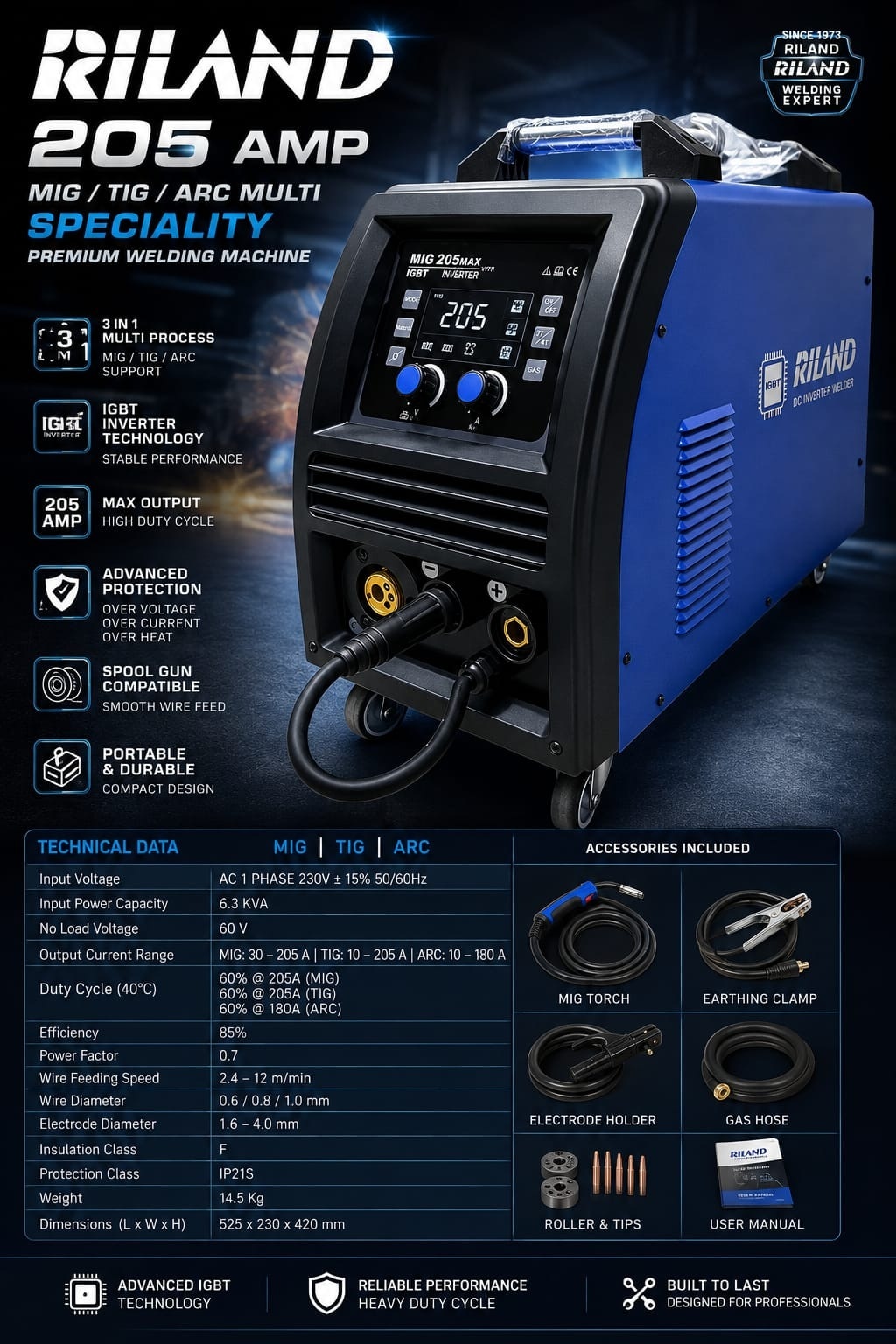 | WELDING MACHINE The RILAND MIG/TIG/ARC Welding Machine is a versatile multi-process welding machine designed for professional fabrication, engineering, repair and... View product → |
Keywords