The extra 50 amps matters only when it expands the usable stud size, weld-current and time range, or production duty cycle for your actual work. By comparing process, material, duty cycle, electrical supply, consumables, and test results, you can select the machine that delivers capacity without paying for unused output.
Key takeaways
- Choose 300 amps when your weld schedule repeatedly approaches 250 amps.
- Match current to stud diameter, welding process, and base-metal thickness.
- Check duty cycle and input power before comparing machine output ratings.
- Prioritise repeatability and production speed over maximum amperage alone.
What does the extra 50 amps change in real fabrication work?
The extra 50 amps provide working reserve, not an automatic 20% increase in speed or stud capacity. A 300 amp output becomes useful when your drawn-arc schedule repeatedly approaches 250 A, uses larger-diameter studs, or needs longer weld times. As stud diameter rises, drawn-arc welding normally requires both more current and more time.
250 amp stud welding machine | 300 amp stud welding machine Working range | Suitable when the schedule stays comfortably below 250 A | Useful when repeated jobs approach 250 A Stud capacity | Smaller structural studs within the published schedule | Larger studs only when the schedule supports them Production benefit | Strong choice for moderate production with adequate duty cycle | Extra reserve for longer cycles or repeated high-load welding Nameplate meaning | Does not guarantee a particular stud size or speed | Does not prove 20% faster welding or 20% larger studs
Compare the manufacturer’s schedule for your exact stud diameter, stud material, base-metal thickness, and shielding method. Check maximum stud diameter, adjustable current and weld-time ranges, delivered or stored energy, and rated output at the duty cycle you need.
A 300 amp machine offers little benefit if the work stays well below 250 A or its higher output lasts only a short cycle. For a search such as 250 amp vs 300 amp stud welder in ahmedabad, treat the 300 amp rating as useful reserve only after those figures match your production schedule.
Which process, stud, and base metal determine the required current?
Choose the welding process before choosing amperage. Capacitor-discharge stud welding releases a very short pulse for smaller studs on relatively thin sheet. Drawn-arc welding uses a longer arc cycle for larger studs and deeper fusion, normally with a ceramic ferrule or shielding gas.
| Process | Stud and work | Main current concern |
|---|---|---|
| Capacitor discharge | Smaller studs on thin sheet | Short pulse limits heat input |
| Drawn arc | Larger studs or deeper fusion | Higher current and longer weld time |
A high-current drawn-arc unit is not automatically suitable for automotive, appliance, or enclosure sheet. Excess heat can cause burn-through, backside marking, distortion, or a visible heat-affected zone.
Before comparing a 250 amp stud welding machine with a 300 amp stud welding machine, record:
- Stud diameter and material
- Base-metal grade and thickness
- Joint access and gun position
- Required surface appearance
- Ferrule or shielding-gas method
Carbon steel, stainless steel, and aluminium need different settings because their electrical resistance, thermal conductivity, oxide behaviour, and polarity requirements differ. A setting that works on mild steel can produce weak fusion or excessive marking on aluminium.
Ask for a weld schedule for the exact stud and base metal, showing current, weld time, lift or plunge settings, polarity, and shielding method. Confirm collet sizes, gun compatibility, ceramic-ferrule dimensions, gas connections, and replacement chuck availability.
Test both machines on production-grade material, not a mild-steel coupon alone. The trial should use the actual thickness, stud, access condition, and appearance standard; otherwise the higher-rated machine can appear suitable while damaging the real workpiece.
How do duty cycle and workshop power affect production capacity?
Production capacity depends on duty cycle at your working current, not the largest number on the nameplate.
Duty cycle states how long the power source can weld within a stated test period and ambient temperature; a 300 amp stud welding machine with a low rating can produce fewer studs per shift than a 250 amp unit with a stronger rating at the same current.
| Comparison | What to check | Production effect |
|---|---|---|
| 250 amp stud welding machine | Duty cycle at scheduled current and workshop temperature | May outperform a higher-rated unit during repeated cycles |
| 300 amp stud welding machine | Current-time range, duty cycle, cooling, and recovery time | Adds capacity only when your work approaches 250 A |
Ask for:
- The complete duty-cycle table at your required current and ambient temperature
- Thermal-protection method and cooling requirements
- Recovery time between welds
- Whether the machine reduces output before tripping
Separate welding output from building supply: 250 A or 300 A describes the welding circuit, not input draw. Obtain input voltage, single- or three-phase arrangement, maximum input current, fuse or breaker size, cable cross-section, earthing method, and generator compatibility.
Include the proposed lead length in the trial. Long or undersized leads increase voltage drop and inductance, while a ground clamp on paint, rust, mill scale, or a vibrating section can cause arc instability and incomplete fusion. Clean the clamp area to bare metal and test the actual workpiece condition.
How should you compare weld quality, speed, and repeatability?
A 250 amp machine is not better because it welds faster, and a 300 amp machine is not better because it has more reserve. Compare the result after both machines weld production-size studs on the actual base-metal grade and thickness.
| Trial point | 250 amp machine | 300 amp machine |
|---|---|---|
| Weld quality | Even flash, continuous fillet, aligned stud | Same acceptance criteria |
| Speed | Cycle time after an acceptable weld | Cycle time after an acceptable weld |
| Repeatability | Results across a production run | Results across the same run |
Prepare the surface by removing paint, oil, rust, and mill scale from the ground-clamp area and weld zone. Position the gun squarely, fit the correct collet, and use the specified ferrule or shielding gas. Record current, weld time, lift, plunge, polarity, lead length, and cooling interval for both machines.
Inspect every trial for even flash, a continuous fillet, correct stud alignment, no visible porosity or lack of fusion, and acceptable deformation. On thin sheet, check burn-through, backside marking, distortion, and heat-affected-zone visibility. On thicker work, check fusion and consistency across the run.
Visual inspection cannot establish load capacity. Add bend, torque, tensile, or macro-etch testing according to the application. For structural or safety-critical work, ask whether the procedure and inspection plan support ISO 14555 requirements. The better stud welder for fabrication workshops holds the required result.
That is the test for a 250 amp vs 300 amp stud welder in Ahmedabad.
Which machine is the better purchase for your workshop?
Choose a 250 amp unit when your stud range, material thickness, production volume, and qualified weld schedule stay within its rated current and duty-cycle envelope. Choose 300 amp when jobs repeatedly approach 250 A, require larger studs, longer repeated cycles, or greater thermal reserve.
Do not pay for 300 A solely because the number is larger.
| Option | Better choice when | Check before buying |
|---|---|---|
| 250 A | Smaller studs and moderate production remain within the schedule | Rated current, maximum stud diameter, duty cycle, and weld-time range |
| 300 A | The 250 A unit reaches its limit or production needs longer repeated cycles | Output at the required duty cycle, cooling, thermal protection, and stored or delivered energy |
For a stud welder for fabrication workshops, compare operating support as carefully as purchase cost:
- Ask Shree Kesar Enterprise or another supplier to demonstrate both machines using your actual studs and base material.
- Compare replacement guns, collets, cables, ferrules, capacitors or control boards, calibration and repair support, service response time, and generator compatibility.
- Request written figures for maximum stud diameter, current-time range, duty cycle, input supply, breaker size, earthing, and thermal protection.
- Include compatible consumables and local availability in the calculation.
When comparing the 250 amp vs 300 amp stud welder in Ahmedabad, a locally supported machine can cost less to operate than a cheaper unit left idle while a gun, cable, or control board is sourced. The best purchase is the one that meets your qualified schedule repeatedly, not the one with the larger nameplate.
Related products
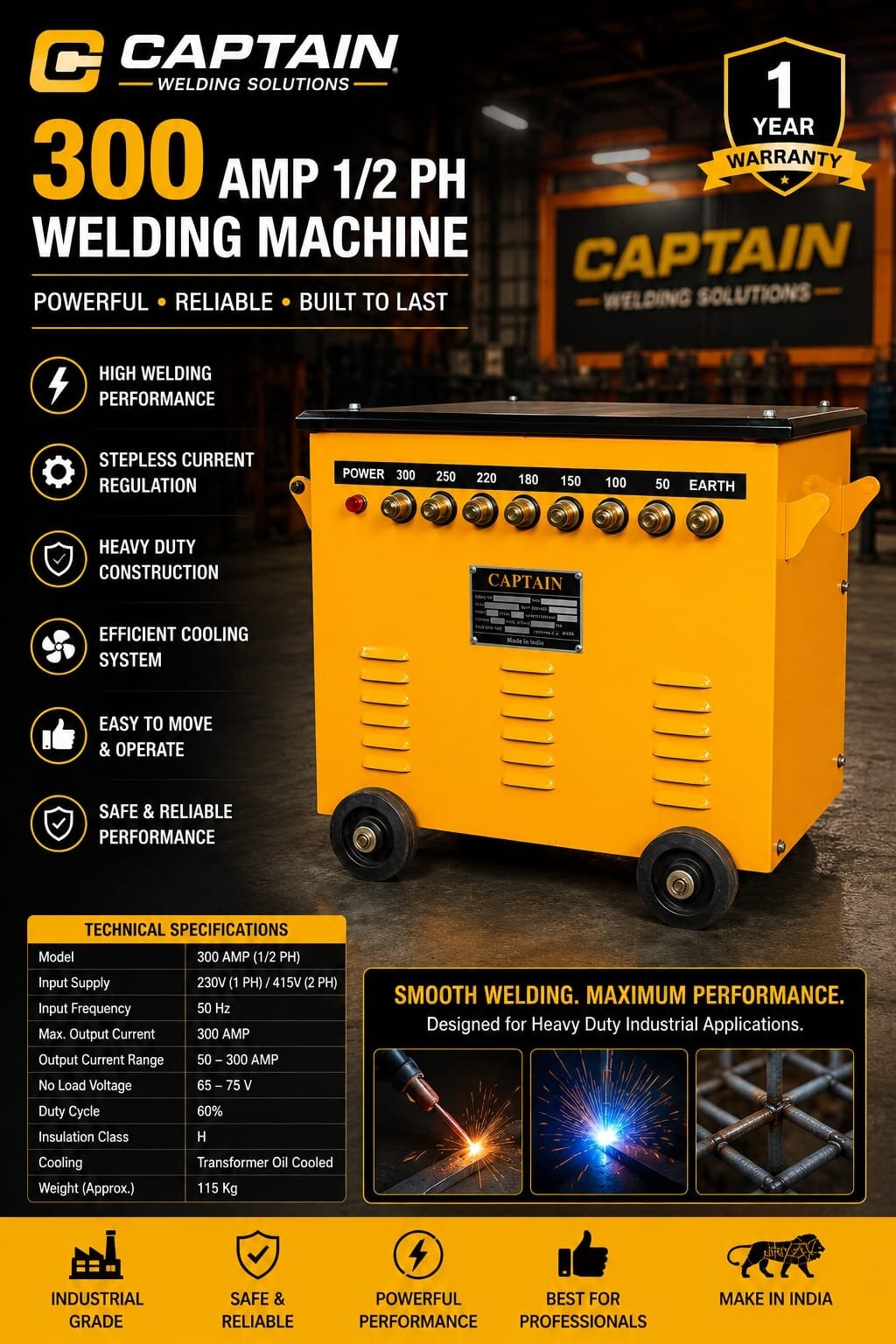 | WELDING MACHINE 300 AMP 1/2 PHASE STUD TYPE WELDING MACHINE The 300 AMP 1/2 Phase Stud Type Welding Machine is a heavy-duty welding machine designed for reliable and efficient welding applications in... View product → |
 | WELDING MACHINE 250 AMP 1/2 PHASE STUD TYPE WELDING MACHINE Shree Kesar Enterprise offers a reliable and efficient 250 AMP 1/2 Phase Stud Type Welding Machine designed for accurate, strong, and consistent stud... View product → |
Frequently asked questions
What does the extra 50 amps change in real fabrication work?
The extra 50 amps provide working reserve when your drawn-arc schedule approaches 250 amps, uses larger studs, or requires longer weld times. It does not automatically increase speed by 20 percent.
Which process, stud, and base metal determine the required current?
Required current depends on the welding process, stud diameter, stud material, base-metal type and thickness, and the weld schedule specified for the application. Larger drawn-arc studs normally require more current and time.
How do duty cycle and workshop power affect production capacity?
Duty cycle determines how long the machine can weld within a rated period before cooling. Confirm that your workshop supply, voltage, phase, breaker, and cabling support the machine's input requirement.
How should you compare weld quality, speed, and repeatability?
Compare completed welds at your actual stud sizes and materials, then check weld time, visual consistency, pull-test results, control settings, and performance across repeated cycles.
Which machine is the better purchase for your workshop?
Choose a 250 amp stud welder when its output covers your current work with reserve. Choose a 300 amp stud welding machine when larger studs, demanding schedules, or future production requirements justify the added capacity.
Keywords